Friday, 19 April 2013

Bari International


Tra le tanti doti degli abitanti di Bari, quello che forse colpisce di più il visitatore è la capacità dei cittadini del capoluogo pugliese di appropriarsi delle ricchezze culturali (e non solo) di altri popoli. San Nicola è stato preso in prestito permanente da Myra, la città vecchia si vanta delle proprie origini arabe, e il senso civico proviene da un altro pianeta. È nota, inoltre, da decenni, l’esistenza di un gemellaggio culturale tra Bari e Parigi (vedi http://baripaul.blogspot.it/2008/07/bari-lezione-di-cultura-per-i-parigini.html), che ha portato alla diffusione nella testa di molte signore baresi non solo dell’idea che “elles sont Catherine Deneuve” ma anche che possono parcheggiare la macchina dove cavolo vogliono.

Con il terzo millennio, però, è arrivato un nuovo capitolo nel fare proprie le risorse degli altri: il barese ha cominciato ad adocchiare la lingua inglese. Non è un’impresa facile: impossessarsi di una lingua richiede molto più tempo e molta più furbizia della rimozione delle ossa di un santo, anche quando per avere la reliquia in questione bisogna andare a vincere fuori casa in Turchia. E in effetti, i primi approcci del barese alla lingua di Shakespeare non sono stati incoraggianti. Basta pensare alla famosa insegna che accoglieva i turisti all’aeroporto (“Welcome in Bari”) o all’insistenza di chiunque sia nato qui nel chiudere ogni “a” in “e”: “I love the rep!” [non nel senso di “Amo il commesso viaggiatore!" ma come apprezzamento della musica rap]; “He is pest this morning” [“He passed by this morning”]; “I go to met you” [I’m going to speak to Matthew”].

Recentemente, però, le cose hanno cominciato a cambiare. Confesso che quando, qualche settimana fa, un’impiegata alla posta ha pronunciato correttamente il mio cognome al momento di consegnarmi una raccomandata, non mi sono preoccupato più di tanto; ho attribuito l’accaduto al semplice fatto che era raffreddata. Ma poi, durante il weekend di Pasqua, un uso spaventosamente corretto del Present Perfect Continuous da parte di un controllore che parlava in treno con dei turisti coreani mi ha messo in allarme. E domenica scorsa, passeggiando a Japigia (non chiedere!), ho avuto la conferma incontrovertibile di quello che temevo:


I baresi ormai non solo hanno la padronanza dell’apostrofo ma sanno usare (e sanno usare bene!) i phrasal verbs. Il giorno è arrivato: non avete più bisogno di me. My work here is done. Me ne vogg.

Friday, 15 February 2013

Allora te la cavi con l'inglese?


Chiunque abbia mai studiato la lingua inglese sa bene quanto sia difficile percorrere la strada che porta dalla conoscenza della grammatica alla capacità di parlare o scrivere. Mettete alla prova le vostre capacità comunicative tentando questa serie di sfide linguistiche.


A. Senza l'aiuto di un vocabolario o di un libro di grammatica, prova a elaborare, in due minuti, quante più risposte possibili alla domanda "What do you do in your free time?" .

B. Prova ad abbinare ogni domanda a una risposta:
1) What time do you get up?
2) What do you have for breakfast?
3) How do you get to school/university/work?
4) Where do you have lunch?
5) Do you ever sleep after lunch?
6) How often do you go out?
7) What do you do in your free time?
8) How do you spend your evenings?
9) What time do you usually go to bed?
 
a) Around midnight.
b) I don’t have any free time.
c) No, but I always feel sleepy.
d) By train.
e) Either watching a DVD or playing games on the computer.
f) Never later than half past six.
g) In the canteen with my colleagues.
h) I never feel hungry in the mornings.
i) Three or four times a week.

C. Senza l'aiuto di un vocabolario o di un libro di grammatica, prova a elaborare, in sei minuti, una risposta personalizzata a ognuna delle 9 domande dell'esercizio precedente.

D. Prova ad abbinare ogni inizio frase (1-10) con una fine (a-j):
1) I get up at…
2) I usually just grab…
3) I rarely…
4) One of my colleagues…
5) Where I have lunch depends…
6) I don’t think my boss would approve…
7) I go out…
8) I spend most of my spare time…
9) By the time I get back…
10) I don’t really have…

a) …a quick coffee
b) …gardening.
c) …a fixed routine.
d) …pretty much every day.
e) …gives me a lift to work.
f) …have time for breakfast.
g) …the crack of dawn.
h) …on how long I have.
i) …if I slept at work.
j) …it’s too late to do anything.

E. Prova a completare le frasi usando le parole fornite sotto:
1) I get up when the ______________ goes off.
2) A ______________ of cereal does me for breakfast.
3) I go to school on ______________ .
4) I grab a quick ______________ for lunch.
5) I like to get my ______________ down for half an hour after lunch.
6) I go out far too often for my parents’ ______________ .
7) I go to the ______________ three times a week.
8) In the evenings I hang out with my ______________ or just collapse on the ______________ .
9) I go to bed around ______________ .

- alarm       - bite        - bowl        - foot       - friends
          - gym      - head       - liking       - midnight         - sofa


F. Abbina a ogni risposta una delle domande dell'esercizio B:
1) __________________________________________________ ?
I have lunch at my grandmother’s.
2) __________________________________________________ ?
I never seem to have any free time.
3) __________________________________________________ ?
I catch the bus.
4) __________________________________________________ ?
Every Saturday night.
5) __________________________________________________ ?
I sometimes cat-nap in the afternoon.
6) __________________________________________________ ?
When my mother calls me.
7) __________________________________________________ ?
When my eyes start closing.
8) __________________________________________________ ?
Most evenings I have to study.
9) __________________________________________________ ?
It depends what time I get up.


LE SOLUZIONI


A. Alcune possibili risposte:
I don’t have any free time.
I listen to music.
Sleep, mostly.
I go running a lot.
I play in a band.
I never seem to have any.
I spend most of my spare time gardening.
I’m trying to write a book at the moment.
It all gets taken up with the children.
I like to get out in the fresh air.
When I’m not helping my mother, I hang out with my friends.

B.
1) What time do you get up? Never later than half past six.
2) What do you have for breakfast? I never feel hungry in the mornings.
3) How do you get to school/university/work? By train.
4) Where do you have lunch? In the canteen with my colleagues.
5) Do you ever sleep after lunch? No, but I always feel sleepy.
6) How often do you go out? Three or four times a week.
7) What do you do in your free time? I don’t have any free time.
8) How do you spend your evenings? Either watching a DVD or playing games on the computer.
9) What time do you usually go to bed? Around midnight.

D.
1) I get up at…the crack of dawn.
2) I usually just grab…a quick coffee
3) I rarely…have time for breakfast.
4) One of my colleagues…gives me a lift to work.
5) Where I have lunch depends…on how long I have.
6) I don’t think my boss would approve…if I slept at work.
7) I go out…pretty much every day.
8) I spend most of my spare time…gardening.
9) By the time I get back…it’s too late to do anything.
10) I don’t really have…a fixed routine.

E.
1) I get up when the alarm goes off.
2) A bowl of cereal does me for breakfast.
3) I go to school on foot .
4) I grab a quick bite for lunch.
5) I like to get my head down for half an hour after lunch.
6) I go out far too often for my parents’ liking.
7) I hang out with my friends .
8) I go to the gym three times a week.
9) I tend to just collapse on the sofa.
10) I go to bed around midnight .

F.
1) Where do you have lunch? I have lunch at my grandmother’s.
2) What do you do in your free time? I never seem to have any free time.
3) How do you get to school/university/work? I catch the bus.
4) How often do you go out? Every Saturday night.
5) Do you ever sleep after lunch? I sometimes cat-nap in the afternoon.
6) What time do you get up? When my mother calls me.
7) What time do you usually go to bed? When my eyes start closing.
8) How do you spend your evenings? Most evenings I have to study.
9) What do you have for breakfast? It depends what time I get up.


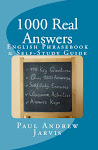
Tutte queste attivita (e le relative soluzioni) sono prese da 1000 Real Answers – English Phrasebook & Self-Study Guide. Il libro è disponibile sia in brossura che in versione elettronica (per Kindle, iPad, iPhone, PC, Mac, ecc.) su amazon.it
http://www.amazon.it/1000-Real-Answers-Language-Questions/dp/1481278525/ref=sr_1_1?ie=UTF8&qid=1356087726&sr=8-1

e anche sui seguenti siti: amazon.com, amazon.uk, amazon.de, amazon.fr, amazon.es, amazon.ca, amazon.co.jp e amazon.com.br.


Sunday, 10 February 2013

Are you good at English?


- Yes, I think I am.
- Not really.
- I’m getting better.
- Not as good as I’d like to be.
- I get by.
- No, I’m completely hopeless.
- People say I am.
- I’m probably not the person to ask.
- No worse than any of my friends.
- I’m good at reading and writing but I find listening and speaking more difficult.
- I can usually make myself understood.
- My teacher doesn’t think so.
- I’m sorry, I didn’t understand what you said.


Sunday, 11 December 2011

Maria Crocefissa - Il Ritorno

Quando ero bambino, l’imminenza di Natale si capiva dal profumo dei mandarini appena sbucciati; da un po’ di anni a questa parte, però, la testimonianza più affidabile della prossimità del compleanno di Gesù viene fornita dall’aroma di pelle non lavata che precede, di ben 15 secondi, l’arrivo sulla soglia del mio ufficio di Maria Crocefissa.

“Professò!” La tradizione vuole che io – momentaneamente stravolto dalla raffica di alitosi che fuoriesce dalle sue labbra – non risponda subito, anche perché il mio cervello è impegnato in un monologo interiore della serie: “To breathe, or not to breathe, that is the question: Whether tis’ nobler in the mind to suffer The stinks and horrors of outrageous hygiene, Or to take arms against the dread cozzala, And with a mazza end her…”

“Professò, volevo salutarvi, professò.” Il suo saluto non cambia mai di una sillaba. Usa gli appellativi come virgolette e enuncia ogni vocale con una smorfia che ti fa pensare che debba soffrire di emorroidi (una riflessione che, per salvaguardare la propria salute mentale, va soppressa più velocemente di un topo rabbioso).

“Professò, vi posso lasciare questo, Professò.” Il “questo” a cui fa riferimento è la lettera che lei scrive ogni anno a Babbo Natale. Da quando, qualche anno fa, le ho regalato un campione di dentifricio alla cozza lasciatomi dal rappresentante di una casa farmaceutica di Fesca, Maria Crocefissa si è convinta che io abbia un rapporto diretto con Santa Claus, e quindi fà sempre in modo di consegnare a me il lungo elenco dei suoi desideri. Con mano sudicia mi porge il foglio, mentre io sento iniziare un attacco di iperventilazione. “Professò, angora nu uei, Professò?”

“No, no. No problem. Puoi lasciarla… lì… lì, su quel… su quel… su quel giornale.”

“Vi ringrazio, Professò, vi ringrazio.” Appena fuori dalla porta si ferma e si gira. “Professò, se vi capita di nuovo di quella aggarbata crema abbronzante che mi avete regalato una volta, non mi offendo, Professò.”

Aspetto che la qualità dell’aria migliori, tiro fuori i guanti di gomma (accessorio ormai indispensabile per chi lavora al contatto con un certo tipo di pubblico) e comincio a leggere...

Thursday, 16 June 2011

Stanislaw Had A Box For Everything – Part 4


Without warning, but just as the good psychiatrist had once predicted it would, the office erupted in a cacophony of noise: glass shattering as words long repressed burst screeching through the screens and broke into a thousand fragmented letters, an escaped Fear Bird squawking in bewildered terror, a beach-hatted figure – whom Stanislaw recognised immediately as his old enemy Sub – baseball batting scarred nursery tunes off the violin he had once loved.

“You locked us away, punk! You locked us away!”

The voice was disconcertingly close, startlingly familiar. Stanislaw turned and gasped in horror, not so much at the sight of the pistol protruding from the screen as at the realisation that the hand holding it was attached to his ten-year-old self.

“Why did you do it, Stani? Did you really think we’d never get out?” The face behind the mask laughed mirthlessly and the hand pulled the trigger. Stanislaw felt his mind and body dissolve away.

This ongoing story, "Stanislaw Had A Box For Everything ", is based on ipad fingerpaintings by Matthew Watkins and Cédric Philippe.

http://www.watkinsmedia.com
http://www.flickr.com/photos/matthew-watkins/
http://cedricphilippe.blogspot.com/
http://www.flickr.com/photos/41631388@N02/


Matthew's Fingerpaintings will be on display from June 18th - 26th at the Sala Murat, Bari, Italy.

Friday, 10 June 2011

Stanislaw Had A Box For Everything – Part 3


Precisely when Stanislaw had blacked out was not clear to him, but he sensed he was now waking into one of the old nightmares. Like when he was in the clinic and they were drugging his porridge.

From somewhere close by, in the dead tones of a hostage imprisoned in an interminable loop, a vaguely familiar voice was repeating the refrain: “Good evening, this is the news. You can’t box up emotion.” Cold-sweating, Stanislaw looked around him. His cartons had morphed into battered TV sets with screens striving primordially to burst into life, and hellish green swamp vapours were rising from the floorless depths of the Box Chamber. He shuddered.

The voice suddenly dissolved into eerie laughter that caused Stanislaw to start. The bad psychiatrist! Terrified now, he looked up, but the face on the screen was not the one he so feared. It belonged to a wild-eyed macaque which, as it caught his eye, broke off its cackling and enquired facetiously: “How you gonna cope wi’ life as a dwarf penguin, man? You got yourself a cool box wi’ fish?”

This story, "Stanislaw Had A Box For Everything ", is based on ipad fingerpaintings by Matthew Watkins and Cédric Philippe.
Matthew Watkins:
www.watkinsmedia.com
http://www.flickr.com/photos/matthew-watkins/
Cédric Philippe:
http://cedricphilippe.blogspot.com/
http://www.flickr.com/photos/41631388@N02/.

Monday, 6 June 2011

Stanislaw Had A Box For Everything - Part 2


“One of the boxes is open.” The thought raced back and forth unchecked like a crazed moth across the uncluttered whiteness of Stanislaw’s middle-mind. Seconds, perhaps minutes, passed before – as the good psychiatrist had assured him it always would – the darkness of reason began to exert its calming effect on this latest mental intruder.

“Impossible,” he told himself. “The vacuum-locking system CANNOT fail.” Clutching the table, he blink-breathed to a count of thirty, then straightened up, relief exploding magically in his belly. “Unless…”

Panic-stricken now, Stanislaw pulled the table aside, fell to his knees and wrenched open the door to his Box Chamber. The bad psychiatrist had once punched him so hard in the solar plexus that he had felt like he was drowning in air. This was worse: the hands on the pressure gauge were swinging dangerously towards the vertical, the blue safety lights at the back of the Chamber were out, and there was no sign of life. He felt the hair he no longer had prickle terrified on his head, but there was nothing else for it. Stanislaw slid forward into the dark stillness.


This story, "Stanislaw Had A Box For Everything ", is based on ipad fingerpaintings by Matthew Watkins and Cédric Philippe.
Matthew Watkins:
www.watkinsmedia.com
http://www.flickr.com/photos/matthew-watkins/
Cédric Philippe:
http://cedricphilippe.blogspot.com/
http://www.flickr.com/photos/41631388@N02/.